Home » News » Cobot vs. Industrial Robot: How to Choose for Your Application
Robotics
Cobot vs. Industrial Robot: How to Choose for Your Application
Robots are taking on the work that is hardest to staff, most repetitive or hardest on people. The first question most manufacturers ask is whether they need a cobot or an industrial robot.
Quick Answer
Cobot vs. industrial robot comes down to payload, speed and who shares the work area. Choose a collaborative robot (cobot) for lighter payloads, moderate speeds, tight floor space, frequent changeovers and tasks where people work nearby. Choose an industrial robot for heavy payloads, high speeds, long reach and harsh environments. Either way, safety comes from how the full application is designed and assessed, not from the robot alone.
Key Takeaways
Most cobots handle about 3 to 30 kg. Industrial robots range up to 1,000+ kg.
Count the gripper and tooling in the payload. Tooling weight often rules out a cobot.
Every application needs a risk assessment, cobot or not (ISO 10218, revised 2025).
Palletizing can go either way. Case weight, line rate and stack height decide it.
The answer depends on what you are moving, how fast it needs to move and who is working around it. This guide compares the two side by side and walks through the questions that decide the right fit.
What is a cobot?
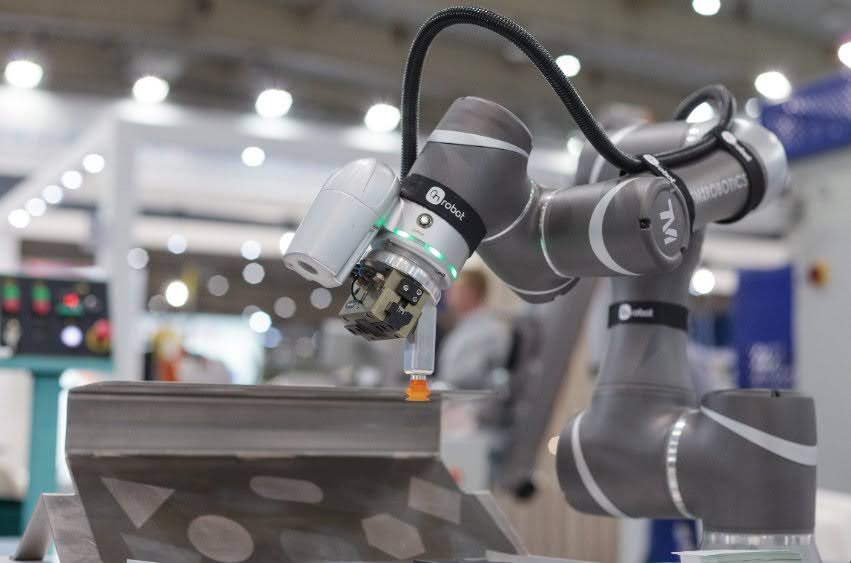
A cobot is a robot designed to share space with people when the application is designed and assessed for it. Cobots use built-in force and power limiting, rounded surfaces and safety-rated monitoring to reduce risk if contact happens.
Cobots are typically lighter, easier to program and easier to move between tasks. Most cobot models handle payloads from about 3 kg to around 30 kg.
Payloads range from a few kilograms to well over 1,000 kg on the largest models, and industrial robots run at much higher speeds than a cobot working alongside people. They usually operate inside a guarded cell, or with safety devices that slow or stop the robot when a person approaches.
Cobot vs. industrial robot: side-by-side comparison
Factor
Cobot
Industrial robot
Payload
Light to moderate, about 3 to 30 kg on most models
Light to very heavy, over 1,000 kg on the largest models
Speed
Moderate, and limited when people are in the work area
High, built for short cycle times
Reach
Short to medium
Short to very long
Footprint and guarding
Small; guarding needs depend on the risk assessment
Larger; usually fenced or protected with light curtains or scanners
Programming
Hand guiding and graphical interfaces
Teach pendant and offline programming, usually by trained programmers
Changeover
Easy to redeploy between tasks
Best for dedicated, high-volume tasks
Environment
Clean to moderate industrial settings
Wide range, including hot, dusty or washdown areas with the right ratings
Heavy palletizing, welding, material removal, painting, high-speed handling
Before You Choose
Seven questions to ask before you choose
01
What is the total payload?
Add the weight of the part and the end-of-arm tooling, including grippers, vacuum cups and sensors. Tooling weight is often what pushes an application past a cobot’s rating.
02
What cycle time do you need?
If the line depends on maximum speed, an industrial robot is usually the better fit.
03
Will people work in or near the robot's space?
Frequent interaction favors a collaborative application. Occasional access can be handled with safety devices on either type.
04
How much floor space do you have?
Cobots often fit into existing lines with a smaller footprint.
05
How often will the task change?
A high product mix and frequent changeovers favor a cobot.
06
What is the environment?
Heat, dust, washdown and heavy loads call for robots rated for those conditions.
07
What comes next?
Plan for future volume. A task that fits a cobot today may need an industrial robot if throughput doubles.
How does safety work for cobots and industrial robots?
ISO 10218 is the global safety standard for industrial robots, and its 2025 revision was the first major update since 2011. The revision brought the safety requirements for collaborative applications, previously published separately as ISO/TS 15066, into the standard itself.
The revised standard also uses the term “collaborative application” instead of “collaborative robot.” The reason is practical: whether a robot can safely work alongside people depends on how it is used, not just on the robot.
What that means on the plant floor:
A cobot still needs a risk assessment. The assessment covers the robot, the tooling, the part and the task. A sharp part or a heavy gripper can change what safeguards are needed.
An industrial robot can work near people. Light curtains, laser scanners, safety controllers and interlocked guarding can slow or stop the robot when someone approaches.
Local adoption matters. In North America, ISO 10218 is adopted as ANSI R15.06 in the U.S. and CSA Z434 in Canada.
Machine tending, such as loading and unloading CNC machines
Light case palletizing at the end of the line
Pick-and-place and secondary packaging
Screwdriving and light assembly
Inspection paired with machine vision
Good fits for an industrial robot
Heavy case or bag palletizing
Welding
Material removal, grinding and polishing
High-speed pick-and-place
Large or heavy part handling
Palletizing can go either way. Case weight, line rate and stack height decide which robot fits. Our guide to when manual palletizing stops making sense covers those factors in more detail.
What does each cost?
Cobot arms usually cost less up front than comparable industrial robots, but the arm is only part of the total. A complete system also includes:
End-of-arm tooling
Safety devices and guarding
Bases, stands and cable management
Integration, programming and commissioning
Training and ongoing support
Compare the total system cost against the labor, throughput and quality gains for your application. For automated palletizing, a typical ROI window is 12 to 36 months.
Robotics
Do you have to choose just one?
Not always. Some plants use cobots for flexible, lower-volume tasks and industrial robots for high-volume ones. Others pair an industrial robot with area scanners that slow it down when a person enters the zone, keeping full speed when the area is clear.
Sometimes, but not automatically. A risk assessment of the full application decides what safeguards are needed. The robot’s built-in safety features are one part of that assessment.
Yes, for lighter cases at moderate rates. Heavier cases, higher rates or taller stacks typically call for an industrial robot or a conventional palletizer.
Cobots are easier to program, but most applications still benefit from expert help with tooling, safety assessment, part presentation and connecting the robot to the rest of the line.
Yes, with the right safety design. Light curtains, laser scanners, safety controllers and fencing protect people while the robot runs.
Find the right robot for your line
Tavoron’s application engineers help manufacturers compare robot types, select end-of-arm tooling and plan safe, productive cells, from a single cobot to a fully integrated system.
Robert Komljenovic is an experienced industrial and automation executive with more than 30 years of leadership across global manufacturing and automation organizations. As President of Automation Integration at Tavoron, he leads the company’s Automation Integration segment, focusing on strategic growth, operational performance, and collaboration across the platform. Prior to joining Tavoron, Robert held executive leadership roles in automation and advanced manufacturing companies, where he led business transformation, expanded market presence, and drove profitable growth. Robert also serves on the Society of Manufacturing Engineers Educational Foundation Board of Directors, supporting STEM education initiatives through scholarship and endowment programs.
To provide the best experiences, we use technologies like cookies to store and/or access device information. Consenting to these technologies will allow us to process data such as browsing behavior or unique IDs on this site. Not consenting or withdrawing consent, may adversely affect certain features and functions.
Functional
Always active
The technical storage or access is strictly necessary for the legitimate purpose of enabling the use of a specific service explicitly requested by the subscriber or user, or for the sole purpose of carrying out the transmission of a communication over an electronic communications network.
Preferences
The technical storage or access is necessary for the legitimate purpose of storing preferences that are not requested by the subscriber or user.
Statistics
The technical storage or access that is used exclusively for statistical purposes.The technical storage or access that is used exclusively for anonymous statistical purposes. Without a subpoena, voluntary compliance on the part of your Internet Service Provider, or additional records from a third party, information stored or retrieved for this purpose alone cannot usually be used to identify you.
Marketing
The technical storage or access is required to create user profiles to send advertising, or to track the user on a website or across several websites for similar marketing purposes.